
Most full-service property managers charge 8% to 12% of the rent they collect each month, and one as iPropertyManagement Research shows the national average in 2026 is near 8.5%. That monthly fee is only part of the bill, though. Leasing, renewal and repair charges can push your real annual cost well past the headline rate, which is why it helps to talk to a local management team with the full fee list in front of you.
Our guide breaks down every common fee, prices the two main fee models side by side, and walks one rental through a full year so you can see what “8%” really costs.
P.S. This is general information for rental owners, not legal, tax or financial advice. Fee ranges below come from national surveys and vary by market and contract.
How much do property managers charge?

As mentioned, property managers in the U.S typically charge 8% to 12% of collected monthly rent for full-service management bringing the national average at about 8.49%, with flat-fee managers averaging around $101 per unit each month. On top of the monthly fee, expect a leasing fee when a new tenant moves in and smaller charges for renewals, setup and inspections.
| Fee type | Typical range | When it is charged |
|---|---|---|
| Monthly management fee | 8% to 12% of collected rent, or a flat monthly amount | Every month the manager collects rent |
| Leasing or tenant placement fee | About 50% to 100% of one month’s rent | Each time a new tenant signs a lease |
| Lease renewal fee | Often $100 to $400, or a share of one month’s rent | When an existing tenant renews |
| Setup or onboarding fee | Often $0 to $300 | Once, when you sign the agreement |
| Maintenance markup | Often 0% to 10% of the repair invoice | On each repair the manager arranges |
| Inspection fee | Often around $100 per visit, if not included | At scheduled inspections |
| Early termination fee | A flat fee or one to three months of management fees | If you end the contract early |
What does the monthly management fee usually cover?
The monthly management fee usually covers the routine work of running a rental: collecting rent, handling tenant questions, coordinating repairs, and sending you monthly statements. What it does not cover varies a lot between companies. Two quotes at 8% and 10% can cost about the same once you check what each one bills separately.
Services usually included in the monthly fee:
- Rent collection and late-rent follow-up
- Tenant communication and maintenance requests
- Coordinating repairs with vendors
- Monthly owner statements and year-end reporting
- Online owner portal access
Services often billed separately:
- Finding and placing a new tenant
- Lease renewals
- Move-in and move-out inspections
- Eviction coordination and court appearances
- Major project oversight, such as a roof or HVAC replacement
Before you compare quotes, line up both companies’ “included” lists side by side. The cheaper percentage is not always the cheaper contract.

What other property management fees should owners expect?
Most managers charge a handful of fees on top of the monthly rate, and they are where owners most often get surprised. Each fee below has a clear trigger. If you know what sets it off, you can estimate what your year will cost before you sign.
Leasing or tenant placement fee
A leasing fee pays for marketing the home, showing it, screening applicants and signing the lease. It typically runs about half to a full month’s rent, and the 2026 Baselane survey puts the bundled average near 71% of one month’s rent. Ask this: is the fee charged again if the tenant leaves in the first few months?
Lease renewal fee
A renewal fee covers the paperwork and rent review when a tenant stays for another term. It is often a flat $100 to $400 or a share of one month’s rent, and some managers waive it. Ask this: is the renewal fee lower than the leasing fee, so the manager has a reason to keep good tenants?
Setup or onboarding fee
A setup fee covers adding your property to the manager’s systems, collecting documents and taking over the lease. Many companies charge a few hundred dollars or nothing at all. Ask this: is the setup fee waived if you sign a longer agreement?
Maintenance coordination markup
A maintenance markup is a percentage added to each repair invoice for arranging the work. It often runs 0% to 10%, though some managers own in-house crews instead. Ask this: is there a repair amount above which the manager must get your approval first?
Vacancy fee
A vacancy fee is a charge for months when the home sits empty. Percentage-based managers usually earn nothing during vacancy, while some flat-fee contracts keep billing. Ask this: do you pay anything in a month when no rent is collected?
Eviction coordination fee
An eviction fee covers the manager’s time filing paperwork and attending court, separate from attorney and court costs. It is usually a flat fee charged only if an eviction happens. Ask this: does the manager offer any protection or guarantee on tenants they placed?
Early termination fee
An early termination fee is what you pay to end the agreement before its term is up. It can be a flat amount or one to three months of management fees, and some contracts bill all remaining fees. Ask this: how much notice is needed, and is there a fee if you sell the home?
Percentage fee or flat fee: which costs you less?
A percentage fee usually costs less on lower rents, and a flat fee can come out ahead on higher rents. Percentage managers also earn nothing when no rent comes in, which ties their pay to yours. The table below compares an 8% fee with a $150 flat monthly fee at two example rents.
| Example monthly rent | 8% fee per month | 8% fee per year | $150 flat fee per year | Lower cost |
|---|---|---|---|---|
| $1,600 | $128 | $1,536 | $1,800 | Percentage |
| $2,200 | $176 | $2,112 | $1,800 | Flat fee |
Illustrative only. Assumes 12 months of collected rent and no vacancy. Please take into account that this isn’t a quote.
The trade-off goes beyond the math. A flat fee stays the same if you raise the rent, but some flat-fee contracts still bill during vacant months. A percentage manager only gets paid when the rent arrives, so slow rent collection hurts them too.
What does property management cost over a full year?
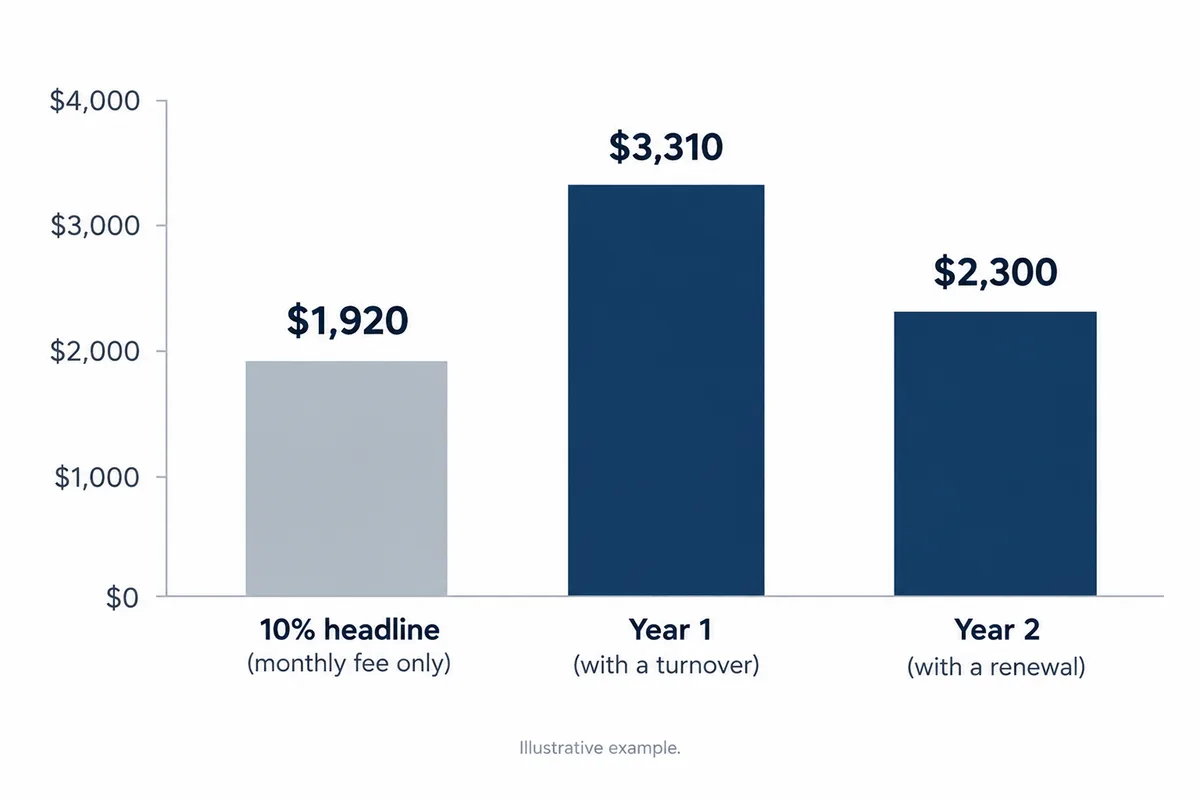
Property management usually costs more over a year than the headline rate suggests, because leasing, setup and repair fees land on top of the monthly charge. In the example below, a 10% quote becomes an effective cost of about 17% of possible rent in a year with a tenant turnover.
Assumptions: $1,600 monthly rent. 10% management fee on collected rent. One month vacant at turnover. Leasing fee of 75% of one month’s rent. $200 setup fee. $1,500 in repairs with a 10% markup. All figures are illustrative.
| Line item | How it is calculated | Annual cost |
|---|---|---|
| Monthly management fee | 10% x $1,600 x 11 months collected | $1,760 |
| Leasing fee | 75% x $1,600, one new tenant | $1,200 |
| Setup fee | One time, first year only | $200 |
| Maintenance markup | 10% x $1,500 in repairs | $150 |
| Total fees | $3,310 | |
| Effective rate | $3,310 / $19,200 possible rent | About 17% |
In a second year where the tenant renews instead of moving out, the picture changes. The monthly fee covers all 12 months ($1,920), a $230 renewal fee replaces the leasing fee, and there is no setup fee. With the same repair markup, total fees come to about $2,300, or roughly 12% of possible rent.
Use this formula to check any quote: (monthly fee x months collected) + leasing or renewal fee + setup fee + (repair spend x markup) = your annual cost. Divide that by 12 months of rent to get your effective rate.
What should NC and TX owners know about property management fees?
In both North Carolina and Texas, someone who manages rentals for other people for a fee generally needs a real estate license, and rent and deposits they collect must be handled under state rules. Before you compare fees, confirm the manager is licensed and ask how your money is held.
North Carolina
North Carolina’s Real Estate License Law (G.S. Chapter 93A) generally requires a property manager who leases or manages homes for others to hold a real estate broker license.
Money collected for owners and tenants, including rent and security deposits, must be kept in a trust account under North Carolina Real Estate Commission rules. You can look up any broker’s license on the Commission’s website. Ask the manager which bank holds the trust account and how often you will get statements.
Texas
In Texas, leasing or managing property for others for a fee generally requires a license from the Texas Real Estate Commission, with some exceptions. TREC offers a public license lookup on its site. Ask the manager who the supervising broker is, how tenant deposits are held, and what their fee schedule says about each charge listed above.
If you own rentals in either state, Legacy Signature Rentals has homes and a local team in North Carolina and in Temple, TX.
What red flags should you look for in a management agreement?
The clauses that cost owners the most are usually about ending the contract, approving repairs and charging during vacancy. Read these parts of any agreement slowly, and ask for changes before you sign rather than after.
- Long termination notice. A 90-day notice period can trap you with a manager who is not performing.
- Termination fee tied to the remaining term. Paying every remaining month’s fee to leave turns a contract into a lock-in.
- No cap on maintenance markup. An open-ended markup rewards bigger repair bills.
- No repair approval threshold. Without a dollar limit, the manager can approve large jobs without asking you.
- Fees on vacant months. You should know exactly what you pay when no rent is collected.
- Leasing fee charged on renewals. A full leasing fee for a tenant who simply stays is a sign of padded pricing.
- Ownership of the tenant. Some contracts charge a fee if you keep a tenant the manager placed after you leave.
- Vague statement schedule. You should know when statements arrive and when owner payouts happen.
Are property management fees tax deductible?
Yes, property management fees are generally deductible as an expense on rental property, and owners usually report them on Schedule E. The IRS explains rental expenses in Publication 527, Residential Rental Property. Because the fee lowers your taxable rental income, its real after-tax cost is lower than the number on the invoice.
This is general information, not tax advice, so confirm your situation with a tax professional.
Is a property manager worth the fee?
A property manager is usually worth the fee when your time, your distance from the property or the size of your portfolio costs you more than the fee does. If you live nearby, have one home and enjoy the work, managing it yourself can make more sense.
The fee is easy to see. The costs of doing it yourself are harder to spot: hours on showings and repair calls, a few extra weeks of vacancy, or one legal mistake on a deposit.

Frequently asked questions about property management fees
What is the average property management fee?
The average property management fee is about 8% to 10% of collected monthly rent for full-service management. A 2026 Baselane survey puts the national average at roughly 8.49%. Leasing, renewal and setup fees are usually charged on top, so compare the total annual cost of each quote, not just the monthly percentage.
Do property managers charge when the home is vacant?
Most percentage-based property managers do not charge the monthly fee when the home is vacant, because the fee is a share of collected rent. Some flat-fee contracts and some agreements with a separate vacancy fee do charge during empty months. Check the agreement for any minimum monthly charge before signing.
Is a leasing fee charged on top of the monthly fee?
Yes, a leasing fee is usually charged on top of the monthly fee each time a new tenant signs a lease. It typically runs about half to a full month’s rent and covers marketing, showings, screening and lease signing. Some all-inclusive plans fold it into a higher monthly rate instead.
Can you negotiate property management fees?
Yes, property management fees are often negotiable, especially if you have several homes, a newer property or a tenant already in place. Owners most often negotiate the leasing fee, the renewal fee, the maintenance markup and the termination terms. Ask for any change in writing as part of the signed agreement.
Who pays for repairs when you have a property manager?
The owner pays for repairs when a property manager is in place. The manager arranges the work, pays the vendor from your rent or a reserve, and shows the cost on your statement. Many agreements let the manager approve repairs below a set dollar amount, so check that limit before signing.
How do I end a property management contract?
To end a property management contract, follow the notice terms in your agreement, which often require 30 to 90 days in writing. Check for an early termination fee and any fee for keeping a tenant the manager placed. Ask for the tenant file, deposit records and keys to be handed over on a set date.