
Self-managing makes sense if you live near the rental, have time during business hours and know your state’s landlord rules. Hiring a manager makes sense when distance, a full-time job or more than one door means your time and risk cost more than the fee. Most owners can settle it with three questions about time, distance and risk, and a short talk with a local management team usually fills in the rest.
We at Legacy Homes Rent, value your time and thus created a guide to show the real prices both sides honestly, including the costs self-managing owners tend to miss, and tells you when doing it yourself is the better call.
P.S. This is general information for rental owners, not legal or financial advice. Landlord rules vary by state and city.
When should you hire a property manager?

You should self-manage if you live close, can answer calls during the day and are comfortable with your state’s deposit, notice and eviction rules. You should hire a property manager if any of those are missing. The decision usually comes down to three things, and if two of the three point toward hiring, hiring is often the safer choice.
| It comes down to | Lean toward self-managing | Lean toward hiring |
|---|---|---|
| Time | Flexible schedule, free hours each month | Full-time job with little daytime flexibility |
| Distance | Within a short drive of the rental | Out of town or out of state |
| Risk tolerance | Comfortable with landlord law and tenant issues | First rental, or a bad tenant experience before |
What does self-managing a rental actually involve?
Self-managing a rental means doing every task a property manager would do, from marketing and screening to repairs, bookkeeping and move-out accounting. Most months are quiet. The work bunches up at turnover, when a single vacancy can take dozens of hours over a few weeks.
| Task | How often | Typical time (estimate) |
|---|---|---|
| Marketing and showings | Each vacancy | 5 to 15 hours |
| Screening applicants | Each vacancy | 2 to 6 hours |
| Lease prep and signing | Each new lease | 1 to 3 hours |
| Rent collection and follow-up | Monthly | Under 1 hour, more if rent is late |
| Maintenance calls | Several times a year | 1 to 3 hours each |
| Finding and scheduling vendors | Each repair | 1 to 2 hours |
| Inspections | Move-in, move-out, periodic | 1 to 2 hours each |
| Bookkeeping and tax records | Monthly and at year-end | 1 to 2 hours a month |
| Renewals and rent reviews | Yearly | 1 to 2 hours |
| Move-out and deposit accounting | Each turnover | 2 to 4 hours |
| Eviction, if needed | Rare | Many hours plus court dates |
What does a property manager take off your plate?
A property manager takes over the tasks above and becomes the tenant’s main contact. In practice, that usually means:
- Pricing the home and marketing it when it is vacant
- Screening applicants against written criteria
- Collecting rent and handling late payments
- Taking maintenance requests and sending vendors
- Running move-in and move-out inspections
- Keeping records and sending owner statements
- Handling renewals and notices

What does each option really cost?
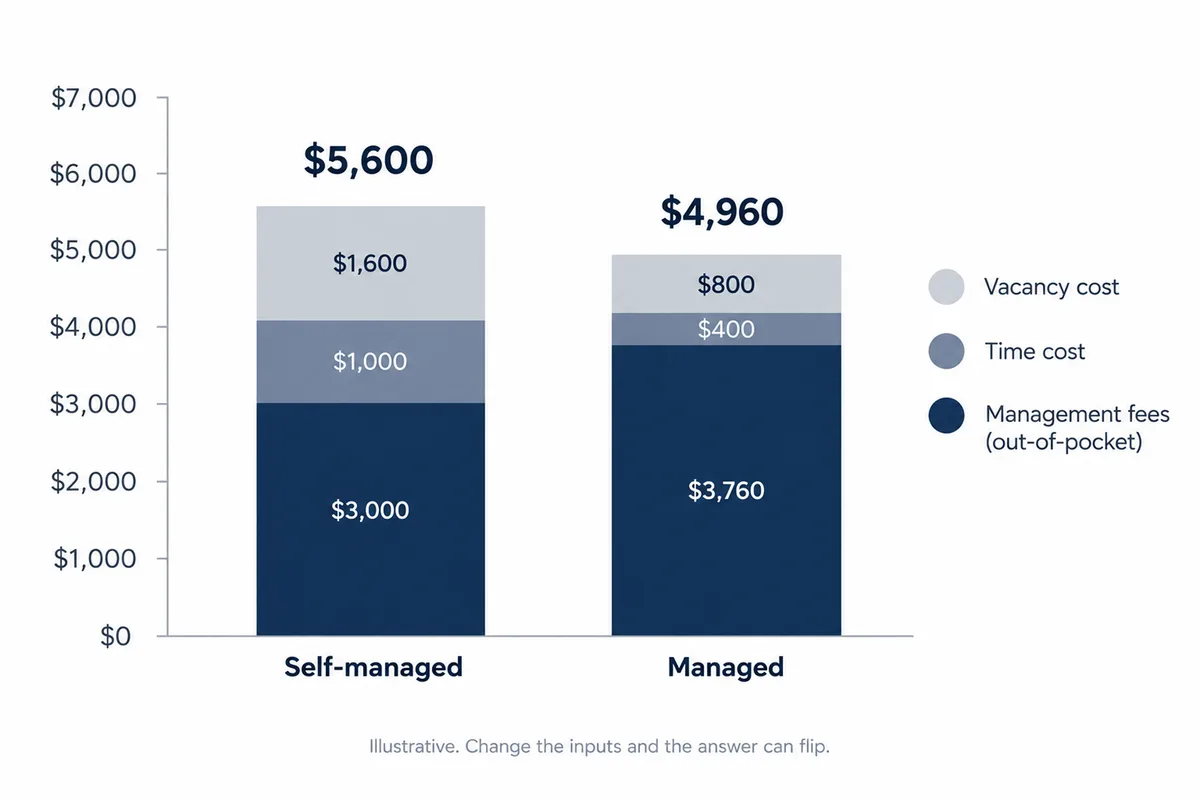
Self-managing saves the management fee but costs you time, and often a few extra weeks of vacancy. Hiring costs the fee but usually takes most of the time off your hands. In the example below, the two options land close together, which is why your own hourly value and vacancy risk decide the answer.
Assumptions: $1,600 monthly rent, one tenant turnover in the year. Your time valued at $40 an hour (use your own number). Self-managed vacancy of 45 days. Managed vacancy of 30 days. 10% management fee on collected rent plus a leasing fee of 75% of one month’s rent. All figures are illustrative.
| Cost | Self-managed | Professionally managed |
|---|---|---|
| Management and leasing fees | $0 | $2,960 |
| Your time | 80 hours x $40 = $3,200 | 10 hours x $40 = $400 |
| Lost rent from vacancy | 1.5 months = $2,400 | 1 month = $1,600 |
| Total annual cost | $5,600 | $4,960 |
Illustrative only. Faster leasing with a manager is an assumption, not a guarantee. Repairs are left out because the owner pays for them either way.
Change one assumption and the answer flips. If your vacancy is short and you value your time at $15 an hour, self-managing wins. If one bad placement leads to an eviction, the managed column often wins by thousands.
Use this to test your own rental: your hours x your hourly value + expected vacancy x monthly rent + fees = your annual cost. Run it for both options and compare.
What legal responsibilities come with self-managing in NC and TX?
When you self-manage, you personally carry the landlord’s legal duties, including security deposit rules, required notices, repairs, fair housing and the eviction process. The points below are a starting list, not a full summary of the law.
North Carolina owners
- Security deposits are capped under the Tenant Security Deposit Act (G.S. 42-50 to 42-56): two weeks’ rent for week-to-week, one and a half months for month-to-month, and two months for longer leases.
- Deposit returns generally must be made, with an itemized list of deductions, within 30 days after the tenancy ends.
- Repairs fall under the Residential Rental Agreements Act (G.S. 42-38 onward), which requires landlords to keep homes fit and safe.
- Evictions go through a court process called summary ejectment. Changing locks or removing belongings yourself is not allowed.
- Fair housing rules apply to every listing, screening question and denial.
Texas owners
- Security deposits are governed by Texas Property Code Chapter 92. Texas sets no statewide cap on the amount, but returns are generally due within 30 days after the tenant moves out and gives a forwarding address.
- Repairs that affect health or safety must be made after proper notice from the tenant.
- Notices, including notice to vacate, have specific timing rules in the Property Code and the lease.
- Evictions go through the justice court. Lockouts and utility cutoffs have strict limits.
- Fair housing rules apply, under both federal law and the Texas Fair Housing Act.
Take into account that Federal Fair Housing Act rules apply in both states.
When does self-managing make sense?
Self-managing makes sense when the rental is close by, the tenant is stable and you have the time and interest to handle calls and repairs. It is a real option, and for some owners it is the better one.
- You own one home within a short drive.
- Your schedule lets you answer calls and meet vendors during the day.
- You already have a trusted plumber, electrician and HVAC company.
- You enjoy the work and want to learn landlord law.
- You have a long-term tenant who pays on time and rarely needs repairs.
- The rent is low enough that a management fee would wipe out most of your cash flow.
When does hiring a property manager make sense?
Hiring a property manager makes sense when distance, time or inexperience puts your rent and your legal standing at risk. These are the situations where the fee most often pays for itself.
- You live out of state or moved away from the rental.
- You own several homes, and turnovers overlap.
- Your job leaves little room for daytime calls.
- This is your first rental and you are unsure of the law.
- A past tenant cost you money or ended in eviction.
- You inherited the home or became a landlord by accident.
Is there a middle option?
Yes. Some managers offer limited services, so you can pay for help with the hardest parts and handle the rest yourself. These options suit owners who live nearby but do not want to run every turnover alone.
Leasing and tenant placement only
A manager markets the home, screens applicants and signs the lease, then hands day-to-day management back to you. You pay a one-time placement fee instead of a monthly fee. It suits owners who are comfortable with repairs but want help with screening.
Maintenance coordination only
Some companies handle repair requests and vendor scheduling for a smaller monthly fee. You still collect rent and deal with the tenant directly. This is less common, so ask before assuming it is offered.
Full management with owner approval limits
Full management with a low repair approval limit keeps you in control of spending. The manager handles everything, but any job over the limit needs your sign-off.
How do you choose a good property manager?
Choose a property manager by checking their license, reading their full fee schedule and asking how they handle money, repairs and vacancies. These questions sort strong managers from weak ones quickly.
- What is your license number? You can check it on the North Carolina Real Estate Commission or Texas Real Estate Commission website.
- How are rent and deposits held? Money collected for owners and tenants should sit in a trust or escrow account.
- Can I see every fee in writing? A full schedule prevents surprises at turnover.
- What is your repair approval limit? This decides how much they can spend without asking you.
- How fast do you respond to maintenance requests? Ask for their standard for emergencies and routine calls.
- When do statements and payouts arrive? You should know the date each month.
- Will I have an owner portal? Online access lets you check rent, repairs and documents anytime.
- What are the termination terms? Look for reasonable notice and no fee tied to the remaining term.
- How long does it usually take you to lease a home? Ask for their average days to lease in your area.
- How do you price renewals? A fair renewal process keeps good tenants longer.
Managing your rental with Legacy Signature Rentals
Legacy Signature Rentals builds and manages rental homes across North Carolina and Texas, so the same team and standards apply from construction through each lease. Owners get reporting through the AppFolio platform, and a local team handles leasing, screening and 24/7 maintenance requests in six markets across both states.

Frequently asked questions about self-managing vs hiring a property manager
How many rentals can one person self-manage?
How many rentals one person can self-manage depends on time, distance and how often tenants turn over. Many part-time landlords handle one to a few homes comfortably. Beyond that, overlapping turnovers and repair calls often become hard to fit around a full-time job, which is when many owners start comparing managers.
Can you self-manage a rental from another state?
Yes, you can self-manage a rental from another state, but it is harder. You will need a local vendor network, a way to show the home and someone to check on it in person. Many out-of-state owners hire a manager or use leasing-only help to cover the tasks that need someone on site.
Do you need a license to manage your own rental in North Carolina?
Generally, no. North Carolina’s license law is aimed at people who manage property for others for a fee, and owners managing their own homes are usually exempt. Anyone managing rentals for someone else for pay generally needs a broker license. Confirm your situation with the North Carolina Real Estate Commission.
Can you switch from self-managing to a property manager mid-lease?
Yes, you can switch to a property manager in the middle of a lease. The existing lease stays in force, and the manager takes over rent collection, repairs and communication. You will need to transfer the tenant’s deposit, the signed lease and records, and tell the tenant in writing where to pay rent.
Does a property manager reduce vacancy?
A property manager can reduce vacancy through faster marketing, set showing schedules and pricing based on local data, but results vary. Ask any manager for their average days to lease in your area. A manager who leases quickly but places weak tenants can cost you more over time.
What is the biggest mistake new self-managing landlords make?
The biggest mistake new self-managing landlords often make is skipping consistent written screening criteria. Approving one applicant on a good feeling and denying another without a clear reason creates fair housing risk and often leads to poor placements. Write your criteria down, apply them to everyone and keep records of each decision.