
Most landlords look for a credit score somewhere between 620 and 650, and there is no federal minimum, which means the number is set by whoever owns the building. A 630 with clean payment history often beats a 700 with a recent eviction on file.
If you are below the line, you are not out of options. Federal law gives you specific rights when a score costs you an apartment, and most renters never use them because nobody tells them the rights exist. Start with the documents worth gathering first, then work through what follows.
P.S This is general information for renters, not legal advice.
What credit score do you need to rent a home?
There is no legally required minimum. Each landlord sets their own threshold, so the answer depends on who owns the property and how much competition there is for it.
These are the bands most screening criteria fall into:
| Score range | What usually happens |
|---|---|
| 700 and above | Approved at nearly any property, including competitive markets |
| 670 to 699 | Approved at most standard apartments and houses without conditions |
| 620 to 669 | Usually approved, sometimes with a larger deposit or a co-signer |
| 580 to 619 | Mixed. Individual landlords tend to be more flexible than large management companies |
| Below 580 | Approval needs support: a co-signer, stronger income proof, or a bigger deposit |
Two things shift these numbers. Single-family houses often carry a slightly higher threshold than apartments in managed complexes, because an individual owner carries more of the risk directly. And market pressure matters. A landlord with three empty units in January is more flexible than the same landlord in August.
Industry screening data has long shown approval odds falling steadily as scores drop rather than cutting off at a single line. That is the useful mental model: not a pass or fail gate, but a sliding scale that other parts of your application can push back against.
Why do landlords check credit at all?
They are trying to answer one question: will this person pay rent every month for the next year?
A credit score is a shorthand for payment behavior. It reflects whether you have paid obligations on time, how much debt you carry relative to your limits, and whether anything has gone to collections. None of that is about character. It is a risk estimate, and vacancy plus eviction costs are expensive enough that most owners want some signal before handing over keys.
Once you understand that, the way you approach the application changes. You’re not trying to defend a number. You’re showing that the rent will be paid, and the score is just one piece of the overall picture.
What do landlords actually see on your credit report?
More than the score, and less than you might fear.
What shows up:
- Payment history, including late payments and how late they were
- Accounts in collections, charge-offs, and bankruptcies
- Current balances and how much of your available credit you are using
- Length of credit history and recent applications for new credit
- Public records such as civil judgments, depending on the report type
What does not show up on a standard credit report:
- Your race, color, religion, national origin, sex, familial status, or disability
- Your income or your employer’s opinion of you
- Your rent payments, unless a previous landlord or a rent reporting service reported them
That second list matters. The Fair Housing Act bars landlords from treating applicants differently based on those protected characteristics, and a credit report is not a route around it.
Many landlords run a tenant screening report rather than a plain credit report. That version can bundle credit data with eviction filings and criminal records, which is why two applicants with identical scores sometimes get different answers.
Can you rent with a low credit score?

Yes, regularly. What changes is how much supporting evidence you need to bring, and how early you bring it. The five approaches below are what actually moves applications.
Offer a larger security deposit, within the legal limit
This is the most commonly suggested workaround and the most commonly misunderstood, because several states cap what a landlord can take.
North Carolina is one of them. Under the Tenant Security Deposit Act, G.S. § 42-51, the maximum is two weeks’ rent on a week-to-week agreement, one and a half months’ rent on a month-to-month agreement, and two months’ rent on anything longer. A landlord in the state’s rental market cannot legally take three months up front as a credit workaround, no matter how willingly you offer it.
Not every state sets a cap. Check your state’s rule before you build an offer around this, and treat any landlord who asks for more than the local limit as a warning sign rather than a flexible negotiator.
Add a co-signer or guarantor
A co-signer agrees to cover rent if you do not. Their credit and income get screened in place of, or alongside, yours. This is the single most effective option if you have someone willing, and the one most large management companies already have a written policy for.
Ask two questions before you line one up: does this landlord accept co-signers at all, and what score and income do they require from that person? Some properties require the guarantor to earn a multiple of the rent that a family member may not meet.
Show a rent payment history
Twelve months of on-time rent is the most directly relevant evidence you can produce, and it usually does not appear on your credit report unless someone reported it.
Bank statements showing consistent transfers, cancelled checks, or a signed payment ledger from a previous landlord all work. Some management companies report rent to the credit bureaus as a standard feature, which builds the file for next time even if it cannot help you today.
Bring employer and landlord references
A short letter from a current employer confirming your position and tenure, plus contact details for a previous landlord willing to speak, adds context a score cannot carry. Give the landlord the reference proactively rather than waiting to be asked. It reads as preparation rather than damage control.
Write a brief letter of explanation
If the damage on your report came from a specific event that has ended, say so in three or four sentences. Medical debt, a divorce, a layoff, a period of illness. State what happened, state that it is resolved, and point to what has changed since.
Keep it short and unemotional. A long letter reads as a plea. A short one reads as an explanation.

What happens if you are denied because of your credit?
You get rights, and most renters never use them. Under the Fair Credit Reporting Act, if a landlord denies your application based even partly on a consumer report, they must give you an adverse action notice. The same requirement applies if they approve you but require a co-signer, raise the deposit, or change the lease terms because of what the report said.
That notice has to tell you which screening company or credit bureau supplied the report, state that the agency did not make the decision, and inform you of two rights:
- A free copy of the report that was used, if you request it within 60 days
- The right to dispute anything in it that is inaccurate or incomplete
Request the report. Errors in tenant screening files are common, and mixed records, stale collections, and eviction filings that were dismissed all turn up. If something is wrong, dispute it with the reporting agency in writing. If the denial was accurate, you at least know exactly which item to address before the next application.
One correction worth making: do not dispute accurate information hoping it disappears. Dispute errors. Disputing correct entries wastes the sixty-day window and can flag your file.
How can you improve your credit before applying?
Some changes register within a billing cycle. Most take months. Know which is which before you delay a move for a number that will not shift in time.
Faster, within 30 to 60 days:
- Pay down revolving balances. Credit utilization is one of the heaviest factors in most scoring models, and it updates when your card issuer reports each month.
- Pull your reports from all three bureaus and dispute genuine errors. Free weekly reports are available at annualcreditreport.com.
- Check for accounts you did not open, which is how identity theft usually surfaces.
- Ask to become an authorized user on a family member’s long-standing, low-balance card.
Slower, three months and up:
- Building payment history after a late payment
- Recovering from a collection or charge-off
- Establishing credit from no file at all
The reality check most guides skip: if you need housing in six weeks, credit improvement is not your strategy. Your strategy is documentation, references, and a co-signer. Work the improvement track in parallel for the next lease, not this one.
What happens during the rental application process?
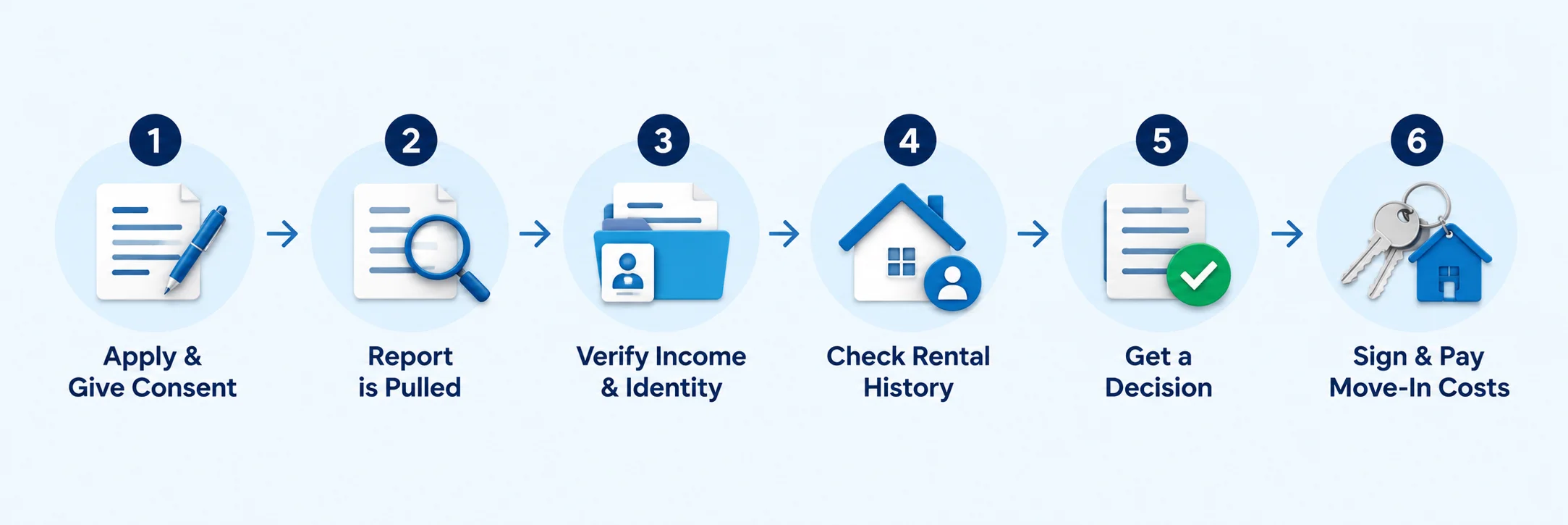
Knowing the sequence removes most of the stress from it.
- You apply and give written consent. A landlord needs your permission before pulling a consumer report. You will typically pay an application fee per adult.
- They pull the report. Screening pulls are frequently soft inquiries that do not affect your score, though this varies by the service used.
- They verify income and identity. Expect to produce recent pay stubs, an offer letter, tax returns if you are self-employed, and a photo ID. Many properties look for monthly income at a multiple of rent.
- They check rental and sometimes employment history. Previous landlords get called. Give accurate contact details.
- A decision comes back. Approval, approval with conditions, or denial with an adverse action notice.
- You sign and pay move-in costs. Deposit, first month, any pet fees, and account setup.
Respond to document requests the same day if you can. Slow paperwork loses more apartments than low scores do, particularly on a unit with several applicants. Timelines vary by property, and the approval turnaround is worth understanding before you give notice at your current place.
What should you ask a landlord before you apply?
Ask before you pay an application fee, not after you are denied. Application fees are rarely refundable, and a two-minute phone call can save you several of them.
- What is your minimum credit score, and is it a hard cutoff?
- Do you accept co-signers or guarantors, and what do they need to qualify?
- If my score is below your minimum, would a larger deposit change the answer?
- What income multiple do you require?
- Do you consider rent payment history that is not on my credit report?
- How long does a decision usually take?
Keep the tone matter of fact. You are gathering criteria, not asking for a favor. Most leasing agents answer these questions directly because it saves them time too.
Final advice: your score is one input, not a verdict
A credit score is a summary of your past, compiled by companies that have never met you, and it is one of several things a landlord weighs. Stable income, a clean rental history, a co-signer, and a straightforward explanation of an old problem all carry weight against a low number.
Landlords need occupied units. Vacancy costs them every month a home sits empty, and that gives you more standing than the application process makes it feel like you have. Prepare the documentation, ask the criteria questions up front, and if you get denied, request the report and find out exactly what you are fixing.
Where you apply also changes the odds. Managed communities tend to publish clear written criteria, which is easier to prepare for than an individual owner’s judgment call, and the differences between unit types often come with different screening standards attached.
Frequently asked questions
What is the minimum credit score to rent a home?
There is no federal minimum. Most landlords set thresholds between 620 and 650, with single-family houses often requiring slightly more than apartments in managed complexes. Below that range, approval usually depends on a co-signer, a larger deposit, or documented income and rent history.
Can I rent with no credit history at all?
Yes, though it takes more documentation. A co-signer is the most reliable route. Proof of consistent rent payments, several months of bank statements, an employment letter, and a larger deposit within your state’s legal limit can also carry an application with a thin file.
Does applying for an apartment hurt my credit score?
Usually not. Many tenant screening services use soft inquiries, which do not affect your score. Some landlords run hard inquiries, which can shave a few points temporarily. Ask which type a property uses if you are applying to several places at once.
How much can a landlord raise my deposit for bad credit?
That depends on your state. North Carolina caps deposits at two weeks’ rent for week-to-week agreements, one and a half months for month-to-month, and two months for longer leases. Other states set different limits or none. Check your local rule before agreeing.
What is an adverse action notice?
It is a written notice a landlord must give you under the Fair Credit Reporting Act when a consumer report leads to denial, a required co-signer, or a higher deposit. It names the reporting agency and tells you how to get a free copy of the report within 60 days.
How long does it take to improve a credit score enough to rent?
Paying down card balances can move a score within one or two billing cycles. Recovering from a late payment, collection, or empty credit file takes months. If you need housing within six weeks, focus on documentation and a co-signer rather than waiting on a score.
Ready to find a place?
Clear written criteria beat guesswork, which is why knowing the requirements before you apply saves both fees and time. Run a full search across North Carolina and Texas, compare all six markets, or ask about the criteria on a specific home before you fill anything out.