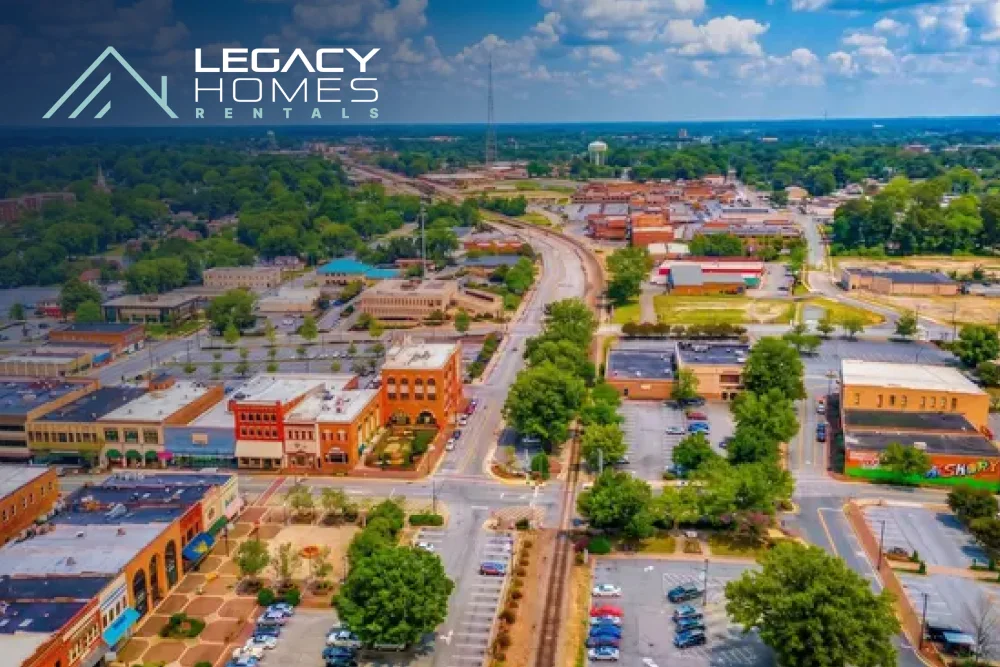
Hickory works for renters who want space and low rent. It doesn’t work for renters who want to get around without a car. Most guides to Hickory are written for people buying houses. This one is for people signing leases.
You can check what’s actually available as you read, listings move weekly in a market this size, and rent varies a lot by neighborhood and unit type. If you’re new to renting, a first-time renter checklist helps you catch what landlords usually ask for before you start touring. The numbers below are current through September 2026, but treat them as starting points rather than fixed figures.
Is Hickory NC a good place to rent?
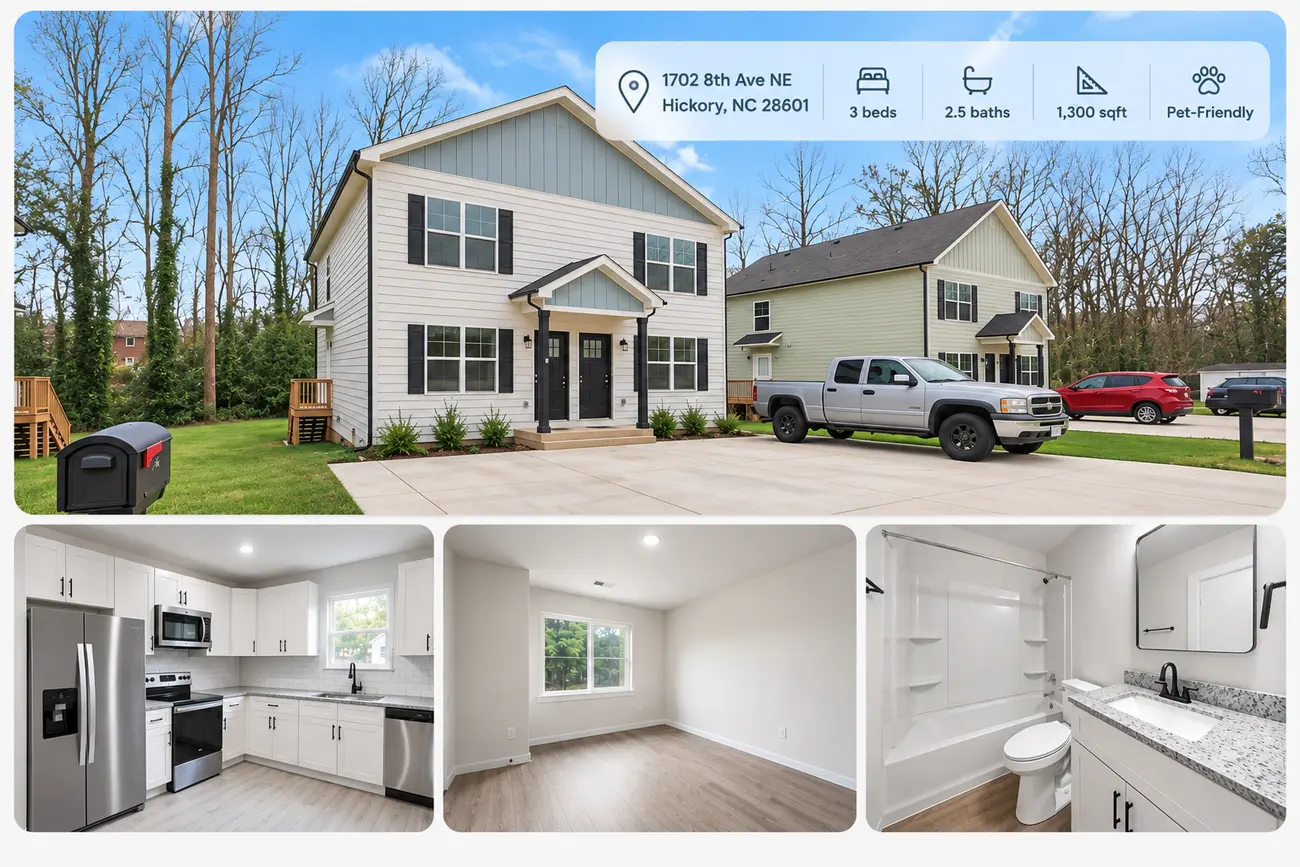
Yes, for most people. Hickory runs about 6–7 percent below the national average on overall cost of living, with housing roughly 14 percent cheaper than the US average according to 2026 data. You get more square footage per dollar than almost anywhere within an hour of Charlotte.
The real constraint is that Hickory is a driving city. Bus service through Greenway Public Transportation exists and it’s genuinely cheap — $1.25 per ride, $45 for a month pass, but it runs limited routes and limited hours. Monday through Friday, 5:45 AM to 6:30 PM. Saturday until 5:20 PM. Yet, on Sundays the service isn’t working. So, if you were counting on getting to work without a car, this isn’t the market.
Hickory suits you if:
- You want a two or three bedroom home rather than a one-bedroom apartment
- You drive, or you work remotely
- You work in healthcare, manufacturing, logistics, or education
- Weekends outdoors matter more to you than weeknights out
Look elsewhere if:
- You need public transit for a daily commute
- You want walkable nightlife outside a few downtown blocks
- Your field only hires in a major metro
What are advantages of living in Hickory?
Hickory stands out for its relatively manageable cost of living, particularly when it comes to housing. But rental prices can vary depending on the source and how the data is calculated.
Affordability, with the numbers attached
Rent figures for Hickory vary a lot depending on who is counting and what they count, so here are two current sources side by side rather than one number presented as fact.
| Unit type | Rent.com (Aug 2026) | Rentometer (Aug 2026, apartments) |
|---|---|---|
| Studio | $975 | $850 |
| 1 bedroom | $1,218 | $1,246 |
| 2 bedroom | $1,200 | $1,435 |
| 3 bedroom | Not listed | $1,636 |
The spread comes from property mix. Older apartment stock pulls averages down. Newer townhomes and single-family rentals pull them up, and those sit higher than the citywide average for a reason: more space, newer systems, private entrances. If you are weighing the difference between unit types, that gap is where it shows up on the lease.
Utilities run below the national average here too, by roughly 7 percent on RentCafe’s numbers. Groceries are the one category that comes in slightly above average.
A job market built on fiber, furniture, and healthcare
The local economy runs on three things. Fiber optics, CommScope and Corning are the big names here, along with manufacturing companies that supply them. Furniture, Century Furniture, McCreary Modern, Lee Industries. And healthcare, with Catawba Valley Medical Center and Frye Regional Medical Center as the main employers.
There’s also a Target distribution center and Performance Food Group handling logistics, which brings steady work.
Parks, trails, and the Hickory Trail build-out
This is where the city has actually spent money. Voters approved a $40 million bond in 2014, and the city has since leveraged it into tens of millions more in grants. City Walk opened in 2021, connecting downtown to Lenoir-Rhyne University. The Riverwalk over Lake Hickory opened in 2024. Together with the Ridgeview Walk and the OLLE Art Walk, they form the Hickory Trail, a network planned to exceed ten miles.
Beyond the trail system, the parks are municipal rather than spectacular. St. Stephens Park in the northeast has a fenced off-leash dog area and a wooded loop. Geitner-Rotary Park anchors the Riverwalk end. Lake Hickory handles boating and fishing. None of it is resort-grade, all of it is free, and it is genuinely well kept.
Community feel that is real, and slower than you expect
People here know their neighbors, and newcomers notice it within a month. The flip side is that the social calendar moves at small-city speed. Making friends often runs through a church, a gym, a kids’ sports league, or work, rather than through going out.
Relocators from larger metros tend to find this either restful or isolating, with very little middle ground.
What to Consider Before Moving to Hickory
Hickory has plenty to offer, but it may not be the right fit for everyone. Before you decide to move, it’s worth looking at a few practical factors that could affect your daily routine and overall cost of living.
Public transportation is limited
Hickory has bus service through Greenway Public Transportation, run by the Western Piedmont Regional Transit Authority, and the fares are genuinely cheap. A single ride is $1.25, an all-day pass is $3, and a 30-day pass is $45. Children five and under ride free, and seniors, riders with disabilities, and Medicare cardholders pay $0.60.
The constraint is coverage and hours. Fixed routes serve Hickory, Conover, and Newton Monday through Friday from 5:45am to 6:30pm, and Saturday from 8:45am to 5:20pm. There is no Sunday service. Stops cluster around the Transit Center at 285 2nd Ave SW and hit destinations like Valley Hills Mall, Catawba Valley Community College, and Catawba Valley Medical Center. A Dial-A-Ride van service covers the wider county at $2.50 per trip, with advance booking.
That is workable for a student or a shift worker on a served corridor. It is not workable as a household’s only transportation.
Muggy summers, and ice more than snow
Hickory gets hot and humid in summer, with July highs averaging around 88°F and humidity lingering from June through August. Winters are much milder, with January lows averaging about 30°F. The area receives roughly 45 to 47 inches of rain each year but typically sees only three to five inches of snow.
That low snowfall number can be misleading. In the western Piedmont, winter weather is often more about ice than snow. Freezing rain can close schools, coat power lines, and make hilly roads dangerous for a day or two. These events are not an everyday occurrence, but when one hits, it tends to be the weather everyone remembers.
A smaller dining and entertainment scene
Hickory has a growing downtown scene, particularly around Union Square and the blocks surrounding it. Since City Walk opened, the area has added more places to eat, local breweries, events, and community activities. You can find enough options for a casual dinner, drinks with friends, or a weekend outing without leaving the city.
That said, Hickory is still a smaller city, and the entertainment options reflect that. Restaurant choices are more limited than what you would find in a larger metro, and some businesses close relatively early. On a typical weeknight, you may find that much of the downtown activity has wrapped up by 9 p.m.
For bigger concerts, major museums, larger entertainment venues, or a much wider selection of restaurants, Charlotte is roughly an hour southeast by car. Asheville is another option, a little farther west, particularly for arts, culture, and its well-known food and brewery scene.
For many Hickory residents, an occasional drive to one of these cities is simply part of living in a smaller community. If you prefer having dozens of restaurants and entertainment options outside your door every night, however, the difference is worth considering before choosing where to live.
Walkability stops at the downtown edge
Downtown Hickory and the City Walk corridor are pleasant on foot. Most residential areas are not. Sidewalks thin out fast, arterials like Highway 127 and Springs Road are built for cars, and grocery runs almost always mean driving. Walk Scores across most of the city sit in car-dependent territory, and that reflects reality rather than a scoring quirk.
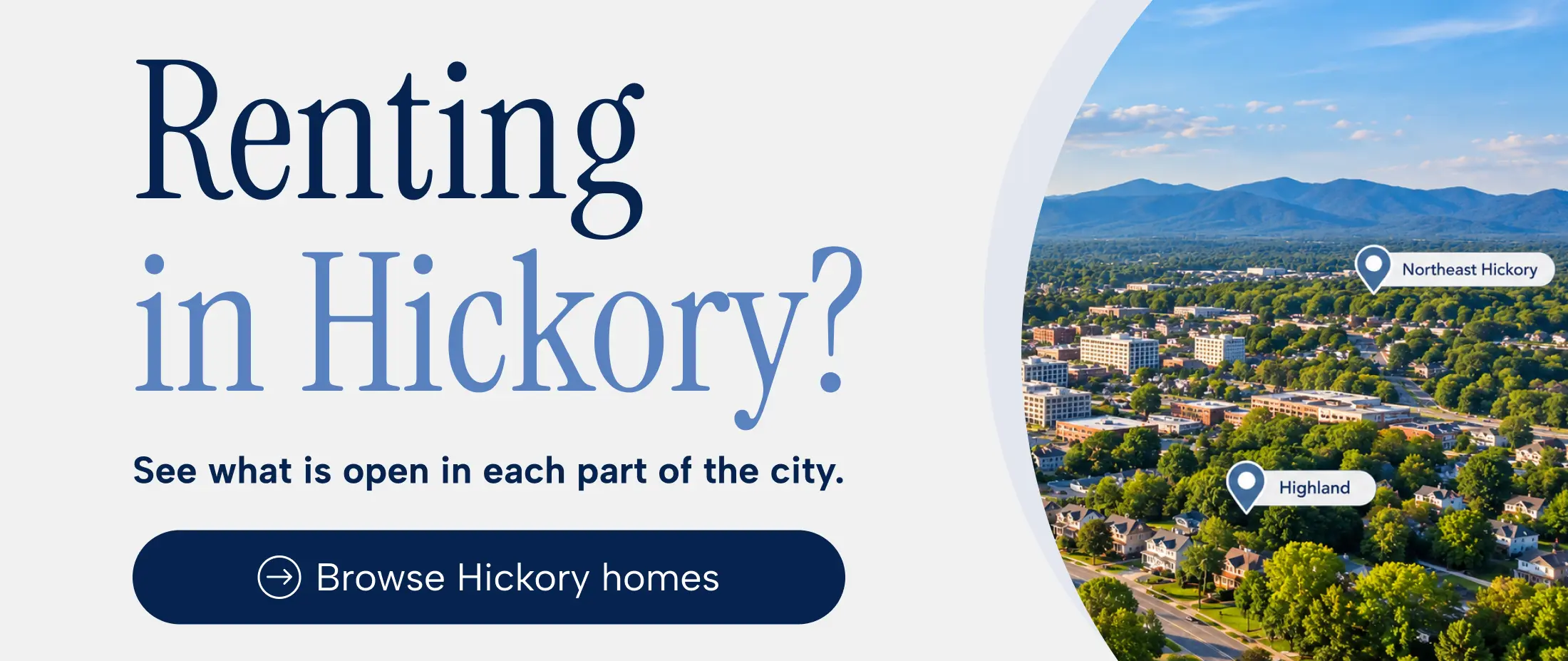
Where renters actually live in Hickory
The city is laid out in quadrants marked NE, NW, SE, and SW on street names, which is the fastest way to orient yourself once you start reading listings.
Downtown and the City Walk corridor
Best for walkability, priciest per square foot. Downtown one-bedrooms run well above the citywide average, and inventory is thin because most of the stock is small. Good fit for a young professional who wants to walk to dinner and does not need space.
Northeast Hickory
The Viewmont area and the streets running out toward St. Stephens Park. Established, residential, quiet, and where a lot of the newer townhome construction has gone in. Errands are close, the park has the best dog facilities in the city, and downtown is a short drive rather than a walk. This is the quadrant that suits families and dog owners best.
Southeast Hickory
Convenient to Lenoir-Rhyne University and to US-70 and I-40 access. A mix of older homes and newer infill, with rents generally below the northeast. Practical for commuters heading toward Conover and Newton.
Southwest Hickory
Near the Transit Center and Catawba Valley Community College, which makes it one of the few areas where bus service is actually useful day to day. Older housing stock, lower rents, and the strongest option for students without a car.
Worth comparing: Conover and Newton
Both sit within fifteen minutes of Hickory and often price lower. A quieter option minutes east trades some convenience for calm, and the county seat to the south puts you in a small-town center with a short drive to Hickory jobs and shopping. If your commute allows it, check both before deciding.
What does it cost to rent in Hickory?

Budget for more than rent. The figures below are the categories that surprise people who move here from a market where more was bundled in.
Monthly rent by unit type
Use the table above as a starting range, then adjust for age and type. A newer three-bedroom townhome will land above the citywide three-bedroom average; a 1970s two-bedroom apartment will land below it. Rental data also ages fast in a market this small, where a handful of new listings moves the average, so treat any published figure as a reference point rather than a quote.
Utilities and other monthly costs
Most Hickory rentals bill electricity, water, sewer, and trash separately from rent, and internet is almost always on you. Utilities here run modestly below the national average. Renters insurance is commonly required and usually runs a modest monthly amount for standard coverage. Ask which utilities are included before you compare two listings on rent alone, because a $50 difference in rent can disappear in a single power bill during a humid August.
Deposits and move-in costs
Before moving in, budget for more than just the monthly rent. You may have a security deposit, an application fee for each adult, and extra costs if you have a pet, such as a deposit or monthly pet rent. Some managed communities also charge a resident benefits fee for services like filter delivery, utility setup, or rent-payment credit reporting.
If this is your first time renting, a first-lease checklist can help you see these costs ahead of time instead of discovering them when you’re ready to sign.
It’s also worth thinking about when you plan to move. Late summer can be a busier time for rentals as the school year approaches, while winter usually brings more available units.
Questions about pricing or move-in details? The leasing team can answer those.
Renting as a student or young professional
Where you live in Hickory can make a noticeable difference depending on your stage of life, budget, and transportation needs. Students and young professionals often prioritize different things, from access to campus and affordable roommates to walkability and space.
Students
Lenoir-Rhyne University sits just east of downtown, and Catawba Valley Community College has its main and east campuses on the bus line. Southwest Hickory near the Transit Center and the CVCC corridor is the most practical area if you do not have a car. Roommate arrangements are common, and older two and three bedroom houses split more cheaply per person than one-bedroom apartments.
Young professionals
Downtown and the City Walk corridor give you the only genuinely walkable evenings in the city, at a premium. If you work remotely and want space over walkability, the northeast quadrant gets you a townhome with a yard for what a downtown one-bedroom costs. Application timelines are worth planning around if you are coordinating a start date, since approval turnaround varies by how quickly you can produce income and reference documents.
So, should you rent in Hickory?
Rent in Hickory if you want more space for less money, you have a car, and you have a job lined up or work that travels with you. The cost math is genuinely good, the trail system is a real amenity rather than a marketing line, and the housing stock has improved noticeably in the last five years.
Look elsewhere if you need transit, if you want a dense restaurant and nightlife scene, or if your career requires a large metro job market. The current softness in local hiring is a reason to secure work before you commit to a lease, not a reason to write off the city.
The deciding factor is usually the quadrant, not the city. A renter in southwest Hickory near the bus line and a renter in a northeast townhome with a fenced yard are having two different experiences of the same place.
Frequently asked questions
Is Hickory NC affordable for renters?
Yes. Hickory’s cost of living runs about 6 to 7 percent below the national average, with housing roughly 14 percent cheaper, according to 2026 RentCafe figures. Average rents across sources fall between about $975 and $1,435 depending on unit type, with newer townhomes sitting above those averages. Before you apply, our first-time renter checklist covers what landlords ask for and what application timelines actually look like in this market.
Do you need a car to live in Hickory NC?
For most residents, yes. Greenway Public Transportation runs fixed bus routes through Hickory, Conover, and Newton on weekdays and Saturdays with no Sunday service, at $1.25 per ride. Coverage works for some corridors but not as a household’s only transportation option.
What is the job market like in Hickory NC?
Manufacturing leads, anchored by fiber-optic producers like Corning and CommScope alongside furniture makers, with healthcare and distribution close behind. Hiring softened through 2025 and early 2026, including a cancelled CommScope expansion, so securing work before relocating is the safer approach.
Which part of Hickory is best for renters?
It depends on your constraints. Downtown offers walkability at a premium, northeast Hickory offers space and parks, southeast is convenient to the university and highways, and southwest near the Transit Center is the most practical area for students or anyone without a car.
How bad are Hickory winters?
Mild by northern standards. January lows average around 30°F and annual snowfall runs only three to five inches. The real winter risk is occasional freezing rain, which can close schools and roads for a day or two rather than heavy accumulation.
How far is Hickory from Charlotte?
Roughly an hour southeast by car via I-40 and US-321. Many residents treat Charlotte as a monthly trip for concerts, dining, and the airport rather than a daily commute, though some do commute along the corridor.